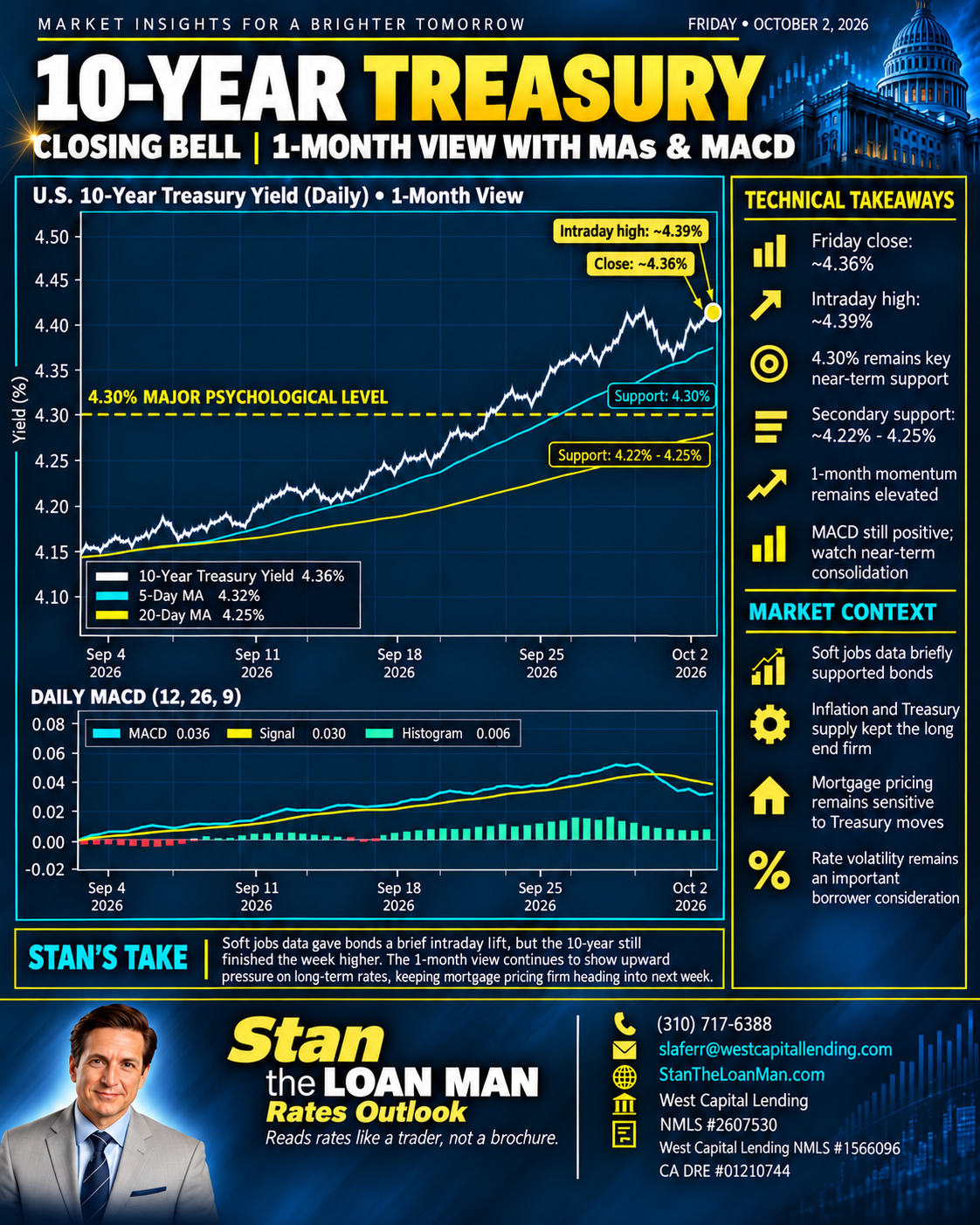
The September employment report gave the bond market exactly the kind of softer labor data it had been waiting for.
But by the closing bell, the message from the Treasury market was more complicated.
The U.S. economy added just 29,000 jobs in September, while the unemployment rate edged up to 4.2%.
July and August payrolls were also revised lower by a combined 60,000 jobs, reinforcing the idea that labor-market momentum has been cooling.
Average hourly earnings rose only 0.1% for the month and were up 3.0% from a year earlier.
That initially sent Treasury yields lower.
The 10-year Treasury yield fell to roughly 5.205% shortly after the employment report as traders reduced expectations for another Federal Reserve rate increase at the October meeting.
But the rally did not hold.
By later Friday, the benchmark 10-year yield had climbed back to approximately 5.281%, up about 4.7 basis points on the day.
It also remained on track for a fifth consecutive weekly increase. Reuters
That reversal is important.
The jobs report was soft — but not soft enough.
At first glance, 29,000 new jobs looks like the kind of number that should be very supportive for bonds.
And it was — initially.
But the bond market is balancing more than employment.
Inflation risk remains elevated.
Energy prices have been volatile.
Global government bond markets have been under pressure.
Treasury supply remains substantial.
And investors continue to demand relatively high yields for taking long-duration interest-rate risk.
Reuters noted that global bond yields have been climbing to levels not seen in roughly two decades, with the U.S. 10-year recently reaching around 5.34%, its highest level in approximately 24 years.
So even a weaker employment report was not enough to reverse the larger trend.
That is the real story of today's Closing Bell.
The Fed matters — but the bond market is still in charge
The employment report substantially reduced expectations for an October rate hike.
Market pricing shifted toward roughly an 80% probability that the Fed would leave rates unchanged at its October meeting.
That is meaningful.
But it is also another reminder that mortgage rates cannot be reduced to a simple question of:
“What will the Fed do next?”
The Federal Reserve controls the federal funds rate.
The 10-year Treasury, mortgage-backed securities market, inflation expectations, Treasury supply, economic growth, global capital flows, and rate volatility all play important roles in determining mortgage pricing.
That distinction was on full display today.
The jobs report made an October Fed hike less likely.
And yet the 10-year Treasury still finished the day higher.
Mortgage rates remain under pressure
Freddie Mac reported on October 1 that the average 30-year fixed mortgage rate rose to 7.28%, up from 7.03% the prior week and 6.34% one year earlier.
That rise matters because housing affordability is already under significant pressure.
For a borrower, the difference between a mortgage rate in the low-6% range and one above 7% can materially change:
- monthly payment
- purchasing power
- debt-to-income qualification
- refinance economics
- and willingness to transact
That helps explain why the housing market can remain slow even when home prices themselves are relatively resilient.
The technical picture
From a market-structure standpoint, I would not interpret today's early Treasury rally as a confirmed trend reversal.
The 10-year reacted positively to softer labor data, but the move faded.
That tells me the market is still wrestling with a broader upward yield trend.
For the technical picture, I would continue watching:
Support: roughly 5.20%, followed by the 5.00% area
Resistance: the recent highs around 5.30%–5.35%
If the 10-year can decisively break back below 5.20% and hold there, that could begin to improve the technical picture.
If yields instead push through the recent 5.34% area, the market may be signaling that the current upward trend has further to run.
The moving averages and momentum indicators remain particularly important here because one softer economic report does not automatically overturn a trend that has been building for weeks.
The biggest takeaway for borrowers is simple:
Do not assume that one weak economic report — or one Fed meeting — automatically produces lower mortgage rates.
Mortgage pricing is constantly repricing new information.
Sometimes the economic data move rates exactly as expected.
Sometimes the market has already anticipated the data.
And sometimes other forces overwhelm the initial reaction.
Today was a good example.
The jobs report was bond-friendly.
Treasuries rallied. Then yields reversed higher.
That is why borrowers may want to think about financing as a strategy, not a single-rate prediction.
Stan’s Take
Today was a very useful market lesson.
The September jobs report was clearly softer than expected.
Payroll growth slowed.
Prior months were revised lower.
Wage growth cooled.
And expectations for an October Fed hike declined.
Yet the 10-year Treasury still ended the session higher.
That tells me the market is saying:
“Employment matters — but it is not the only thing that matters.”
Inflation expectations, Treasury supply, global bond-market pressure, energy prices, and investor demand for duration are all competing forces.
For mortgage borrowers, that means waiting for the next Fed meeting alone may not be a complete strategy.
Sometimes the better signal comes from watching what the bond market itself is actually doing.
And today, the bond market showed that the fight over higher long-term rates is not over yet.
When rates are volatile, it can make sense to evaluate more than just the headline 30-year fixed rate.
Depending on the borrower and property, that may include:
- adjustable-rate mortgages
- interest-only structures
- temporary buydowns
- 3-2-1 buydowns
- permanent rate buydowns
- lender credits
- shorter holding-period strategies
- refinance planning
- and alternative documentation programs where appropriate
The goal is to understand the rate, payment, upfront cost, expected holding period, and future flexibility together.
At West Capital Lending, access to a broad wholesale lender network allows borrowers to compare multiple programs and pricing structures rather than relying on one lender or one loan product.
The next major item I’ll be watching is the Federal Reserve’s September meeting minutes, along with upcoming inflation data.
The labor report reduced the immediate pressure for another October hike, but the bond market is still focused heavily on inflation, energy prices, and the possibility that the Fed may need to remain restrictive longer than previously expected.
That means the next meaningful move in mortgage rates could come from either:
softer inflation data that pushes Treasury yields lower
or
renewed inflation pressure that keeps the 10-year near or above current levels.

Founder, RatesOutlook · Branch Manager & Mortgage Loan Originator, West Capital Lending · NMLS #2607530. Stan writes about mortgage rates, Treasury markets, housing data and borrower financing strategy.